
When Silence Is a Warning Sign: Reading Shutdown Behavior Before It Becomes a Crisis

The student who throws the chair gets the intervention. The student who goes quiet, drops their head, and stops responding often gets nothing — or worse, gets told to sit up and pay attention. In the architecture of a crisis, the silence is frequently the earlier signal. It is also the one most consistently missed.
Understanding shutdown behavior — the freeze and withdrawal responses that sit at the lower end of the escalation arc — is one of the most practical, high-impact shifts an educator or care professional can make in their approach to behavioral safety. It does not require new systems or additional resources. It requires a different way of looking at what stillness and silence are actually communicating.
The Escalation Arc Has Two Directions
Most crisis training focuses on the visible, agitated end of escalation: rising voice, physical tension, verbal aggression, refusal, throwing. These are the behaviors that register as emergencies. They are also, neurologically, a later stage of a process that frequently began much earlier — and much more quietly.

Escalation can move in more than one direction.
Polyvagal theory, developed by researcher Stephen Porges, describes three primary states of the autonomic nervous system: the ventral vagal state of safety and social engagement; the sympathetic state of fight or flight; and the dorsal vagal state of shutdown, freeze, and collapse. That third state — dorsal vagal activation — is the nervous system’s oldest and most extreme protective response. It is what happens when fight and flight are unavailable or have already failed. The organism goes still. It withdraws. It disconnects.
In a classroom or residential setting, this looks like a student who stops talking, stops making eye contact, becomes unresponsive to redirection, puts their head down, or seems to disappear into themselves. It can look like compliance. It can look like indifference. What it rarely looks like, to the untrained eye, is a nervous system in distress — but that is exactly what it is.

Withdrawal can look like compliance when it is actually a signal of distress.
Why Shutdown Is Missed More Often Than Agitation
There are structural reasons that shutdown behavior goes unrecognized. Agitation creates an immediate demand on the adults in the room. It is loud, visible, and impossible to ignore. Shutdown, by contrast, removes the student from the interaction. The classroom can continue. The lesson can proceed. The staff member’s attention is freed for the twenty-eight other students who are present.
This is not indifference but a predictable result of training and attention being directed toward behaviors that require an immediate response. When a student is dysregulating upward — toward agitation and aggression — the need for intervention is obvious. When a student is dysregulating downward — toward freeze and shutdown — the need is less visible but no less real.
Check Out: Managing Conflict in Remote and Hybrid Schools
There is also a cultural habit in many educational and care settings of reading quiet as cooperation. A student who is not disrupting is often assumed to be fine. But shutdown is not cooperation. It is the nervous system’s withdrawal from a situation that has become unmanageable. It can precede a sudden explosive escalation — because dorsal vagal shutdown is not a stable resting state. It is a held breath. When the pressure becomes sufficient, it releases.
What Shutdown Behavior Actually Looks Like
The behavioral signals of shutdown vary by individual and context, but the common thread is a reduction or withdrawal of engagement. A student who was verbally participatory goes silent. A student who maintained eye contact stops. Physical posture collapses — shoulders drop, head goes down, body turns away. Responsiveness to direct questions slows or ceases. The student may appear to be dissociating: present in the body but absent in engagement.
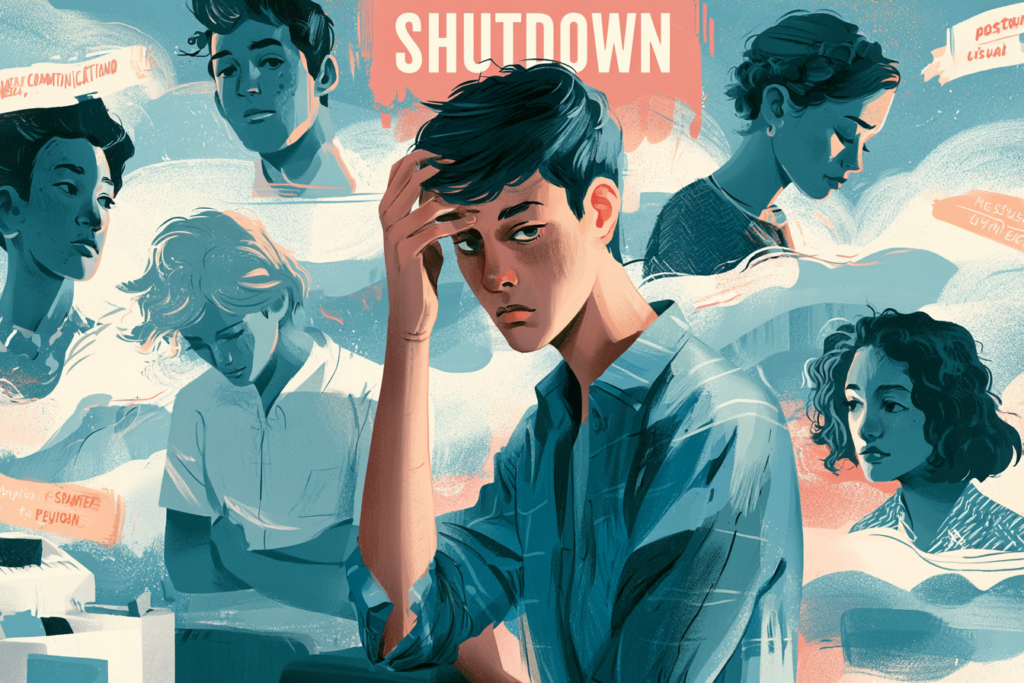
Caption: Small changes in engagement can be meaningful signals.
In students with trauma histories, this response can be triggered by stimuli that appear minor — a tone of voice, a particular phrase, a sensory input that echoes an earlier experience of threat or helplessness. The nervous system does not distinguish between current and historical threat when it is in protective mode. A student who looks like they are ignoring a teacher may be in a neurological state where voluntary response is genuinely impaired.
Understanding this reframes the appropriate adult response entirely. Escalating the demand — speaking louder, increasing consequence pressure, standing closer — is the intervention most likely to push a shutdown student toward explosive escalation. The intervention that works is the one that reduces perceived threat and creates enough safety for the nervous system to begin the return journey toward social engagement.
Reading the Room: Practical Signals Staff Can Train Themselves to Notice

When shutdown is recognized early, the response can shift from pressure to safety.
The shift from recognizing shutdown behavior in theory to catching it in practice is a training question. Staff who have been taught to read the full escalation arc — including its lower end — notice things that untrained staff do not. They track changes from baseline rather than responding only to threshold events. A student who is normally talkative and has gone quiet for twenty minutes is showing a change from baseline. That change is information.

Prevention begins with noticing what others might miss
MindSet Safety Management’s curriculum builds this kind of behavioral literacy as a core professional skill.
The trauma-responsive frameworks give staff a structured way of reading the room — not just for agitation, but for the full range of behavioral communication, including withdrawal. When staff understand that silence can be a signal as urgent as a raised voice, their capacity to intervene early — before the situation reaches a point requiring physical safety measures — increases substantially.
Check Out: Restorative Practices for 2026
Early intervention in shutdown states looks different from early intervention in agitation. It is quieter, slower, less directive. It prioritizes reducing environmental demand, offering low-key connection, and creating conditions of predictability and safety. It does not require a dramatic response. It requires a trained one — delivered by a regulated adult who understands what they are responding to.
The Organizational Implication
Schools and organizations that train staff to read the full escalation arc — including shutdown — reduce both the frequency and severity of crisis events. They catch more incidents at the stage where they are easiest to interrupt. They build a staff culture in which behavioral observation is a shared professional practice rather than an individual instinct. And they send a signal to students and clients that someone in the room is paying attention not only to the noise, but to the silence.

Behavioral literacy begins with learning to notice changes from baseline.
That is the practical case for expanding crisis training beyond the visible end of escalation. The student who goes quiet is communicating something. The organization that has trained its people to hear it is operating with a significant preventive advantage over the one that has not.
Quick Answer
Shutdown behavior — the freeze, withdrawal, and dissociation responses that sit at the lower end of the escalation arc — is one of the most commonly missed early warning signs in schools and care settings. Rooted in dorsal vagal nervous system activation, shutdown often precedes explosive escalation and is frequently misread as compliance or indifference. MindSet Safety Management trains staff to read the full behavioral spectrum, including the quiet signals, so early intervention is possible before crisis events reach their most difficult stage.
Frequently Asked Questions
What is shutdown behavior in students?
Shutdown behavior is the nervous system’s freeze or withdrawal response — a state of dorsal vagal activation in which the student disengages from social interaction, becomes unresponsive, and may appear to dissociate. It is a protective stress response, not deliberate noncompliance.
Why is shutdown behavior harder to recognize than agitation?
Agitation creates an immediate visible demand on adults in the room. Shutdown removes the student from the interaction, allowing the environment to continue without interruption. Many settings are trained to respond to escalation upward; shutdown is escalation downward and is frequently overlooked.
Can shutdown behavior precede explosive escalation?
Yes. Dorsal vagal shutdown is not a stable resting state — it is a held neurological response. When internal pressure exceeds the capacity of that response to contain it, a rapid escalation to fight or flight behavior can follow. Recognizing shutdown early is therefore a critical prevention opportunity.
What triggers shutdown in students with trauma histories?
Trauma-affected students may have a lowered threat threshold in the nervous system, making them more reactive to stimuli that appear minor to observers. A tone of voice, a specific phrase, or a sensory cue that echoes a past experience of danger can activate the shutdown response.
What is the right intervention for a student in shutdown?
Interventions that reduce perceived threat and increase safety — quieter tone, less directive communication, reduced environmental demand, low-key connection — are most effective. Escalating demands or increasing consequences tends to push shutdown students toward explosive escalation rather than re-engagement.
How does MindSet Safety Management address shutdown behavior?
MindSet’s curriculum builds behavioral literacy across the full escalation arc, including the shutdown end. Staff learn to track changes from individual baseline, read nonverbal and behavioral cues, and intervene early with trauma-responsive, neurobiologically grounded strategies.
Is reading shutdown behavior a trainable skill?
Yes. Recognizing the signals of shutdown — changes in verbal engagement, posture, responsiveness, and eye contact — is a professional skill that develops through training and practice. MindSet’s framework gives staff a structured approach to behavioral observation that extends beyond threshold events.
What is polyvagal theory and why does it matter for educators?
Polyvagal theory, developed by Stephen Porges, describes the nervous system’s three primary states: safety and social engagement, fight or flight, and shutdown or freeze. Understanding these states helps educators recognize what a student’s behavior is communicating neurologically, not just behaviorally.
Key Specifications
Core Concept: Shutdown behavior as an early warning signal on the escalation arc
Neurological Framework: Dorsal vagal activation; polyvagal theory
Common Misreading: Shutdown mistaken for compliance, indifference, or disengagement
Risk: Shutdown can precede rapid escalation to fight or flight behavior
Intervention Approach: Reduce perceived threat; increase safety cues; low-directive connection
Intervention Approach: Reduce perceived threat; increase safety cues; low-directive connection
Expert Summary
The most preventable crises are often the ones that began with silence. Shutdown behavior is a neurologically coherent stress response that communicates distress as clearly as agitation — but through withdrawal rather than activation. Staff who have been trained to read the full escalation arc, including its quieter end, carry a significant preventive advantage into every high-demand environment they work in.
MindSet Safety Management builds that capacity through evidence-driven, neurobiology-grounded curriculum. The goal is not only to equip staff to respond to behavioral crises — it is to train them to recognize the signals that make prevention possible before crisis arrives.
*Sources: MindSet Safety Management; U.S. Department of Education.